Would you like to switch to the English site?
This project involves the use of a jigsaw and a mitre saw. Please always prioritise your safety and
use the necessary protective equipment
| Components | Material | Quantity | Dimension in mm |
|---|---|---|---|
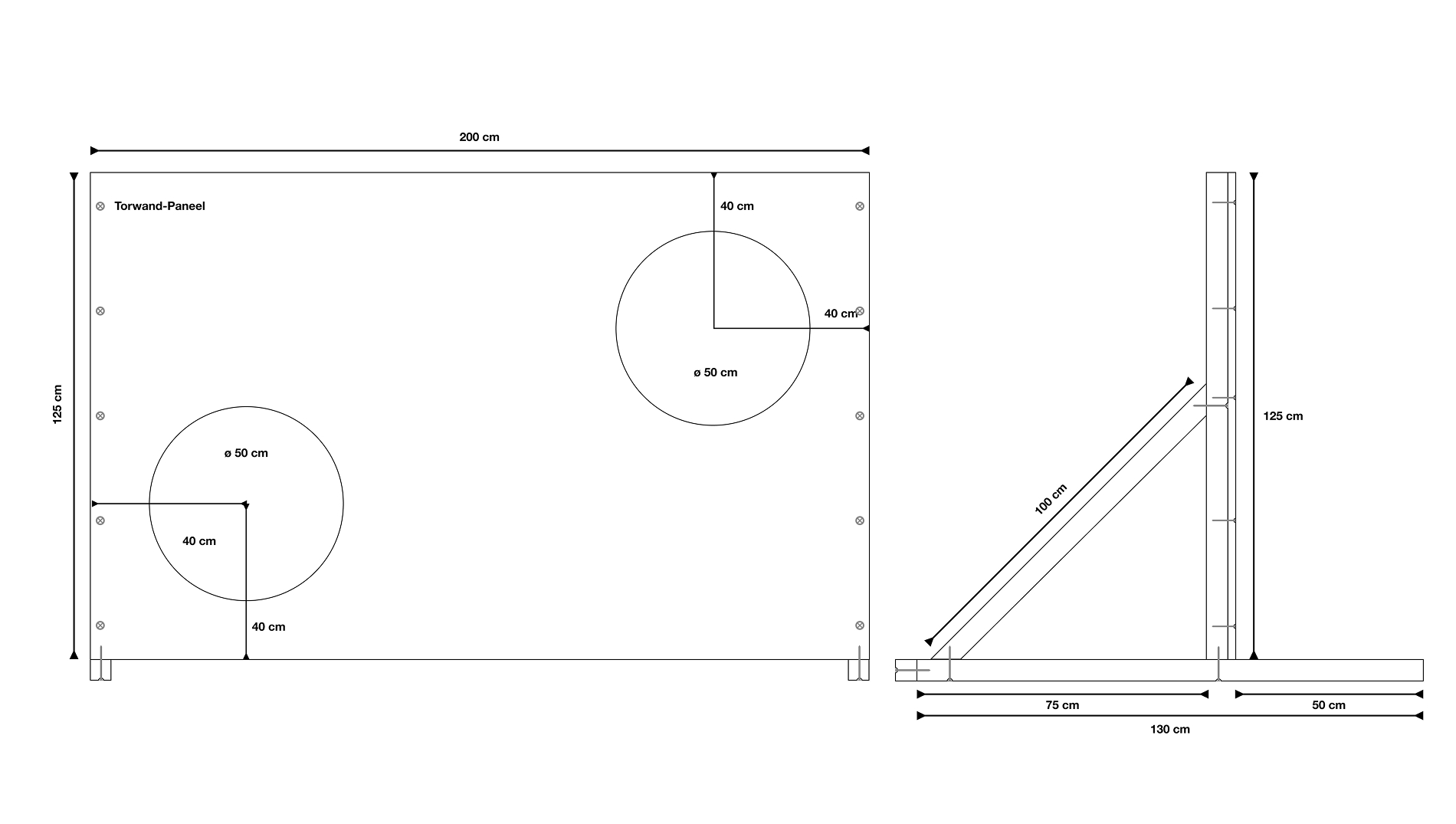
| Goal panel | Multiplex or screen printing board | 1 piece | 200 x 125 x 1,8 cm |
| Vertical support | Square timber, min. 54 x 54 mm | 2 pieces | 125 cm |
| Diagonal support (45°) | Square timber min. 54 x 54 mm | 2 pieces | 100 cm mitred at 45° |
| Bottom rail | Square timber min. 54 x 54 mm | 2 pieces | 100 cm |
| Rear crossbeam | Square timber min. 54 x 54 mm | 1 piece | 200 cm |
| Screws (for the frame) | 5 x 90 mm, galvanised | approx. 20 pieces | - |
| Screws (for the goal panel) | 5 x 50 mm, galvanised | approx. 10 pieces | - |
| Coloured paint | RAL 6005 | approx. 750 ml | - |
| Coloured paint | Gold | approx. 125 ml | - |
| Wood preservative | - | approx. 750 ml | - |
| Sandpaper | P120 + P240 | 2 sheets each | - |
| Clamps | - | - | - |
| Folding rule | - | - | - |
| Pencil | - | - | - |

The frame consists of two identical units that support your goal wall on the left and right.
Each unit consists of:
The two units are connected by a rear crossbar, which stabilises the goal wall.
If you cannot obtain the goal wall panel or beams in the sizes shown here, simply adjust the lengths accordingly.
Have all your tools and materials to hand before you get started. Work through the instructions step by step and follow our experts’ tips. That’s how you successfully cut the round to fit the square. Let’s get started!
Place the plywood panel on a flat surface. Mark the positions of the two holes with a pencil as shown in the diagram. Draw the circle (Ø 50 cm) using a compass, a marking cord or a homemade template. To position the jigsaw, first drill a starting hole inside the circle using the cordless drill.
Position the jigsaw in the starting hole and saw along the circular line. Work evenly and slowly – this will ensure a cleaner cut. Repeat this for the second hole.
Then sand the edges carefully. First with P120 grit, then with P240. The inner edges of the holes in particular must be smooth – if you hit the ball, it will fly through here.
Now build the two stands that will support your goal wall, one after the other.
For each stand, proceed as follows:
The diagonal braces must be cut at a 45° angle – use a PARKSIDE mitre and rip saw for this, or simply ask at your DIY store’s cutting service.
Set up the two units. The crossbeam is screwed to the two posts at the back. Pre-drill first, then secure with 2–3 screws per side.
Rest the panel against the front of your scaffolding. Check that the panel is centred.
Now screw it into each post from the front at at least four points. Start at the top and bottom; this will allow you to align the panel slightly before securing the centre points.
Tip: While screwing, ask someone to hold the scaffolding steady from behind – this step is much easier with two people.
It’s time to add some colour for the PARKSIDE anniversary look!
First, lightly sand the entire front of the goal wall (P240) so that the paint adheres well. Then apply the paint in RAL 6005 – Moss Green – evenly. Apply two coats, allowing each to dry thoroughly in between. Your goal wall now shares the same colour as the tools used to build it.
Next, treat the back of the frame and the cut edges of the holes with wood preservative oil to prevent the wood from swelling. A single coat applied with a brush is sufficient here. The green paint already protects the front.
Use a brush to add the finishing touch: gold rings around the goal holes – one ring per hole. Your PARKSIDE goal wall is now complete. And now off to the pitch!
Warning: Only set up the goal wall on a level surface. We recommend securing the goal wall against tipping over (e.g. by anchoring it or weighing it down).
Do not use the goal wall in windy or stormy conditions. Children should only use the goal wall under supervision.